
The Stormwater Basin vs. Expansion Battle: How One Early Decision Can Limit Future Growth
When planning a new industrial or corporate facility, most owners are focused on the immediate project: the building footprint, truck circulation, parking, and schedule.
Future expansion is usually part of the conversation—but too often, it's treated as a note on the site plan rather than a design strategy.
One of the biggest obstacles to future growth isn't the building itself.
It's the stormwater basin.
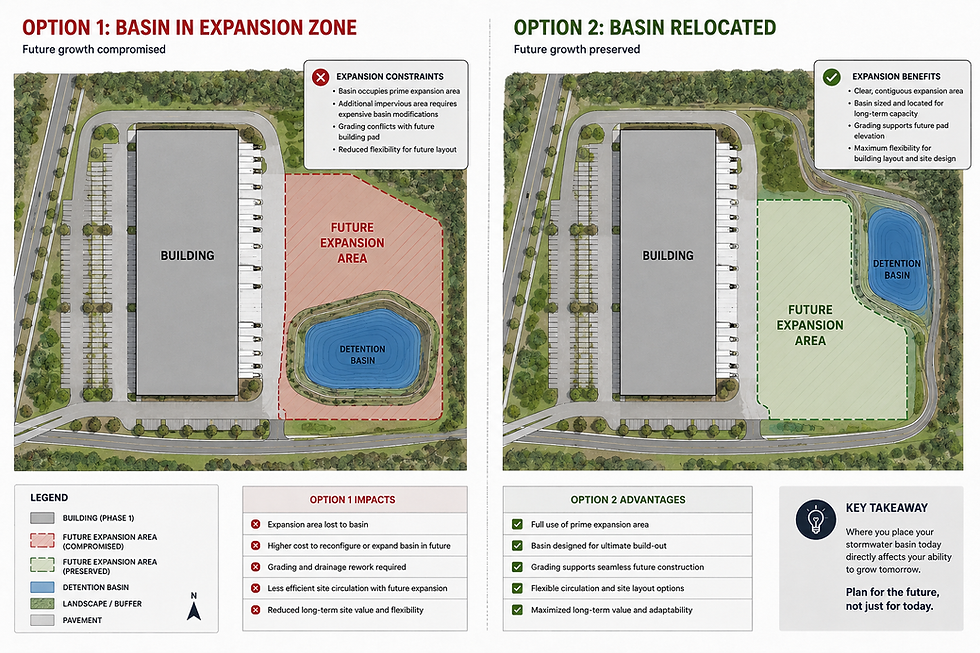
The Expansion Area That Isn't
Many site plans include a shaded area labeled "Future Expansion."
On paper, it looks straightforward. There's open land adjacent to the building, and when the business grows, that's where the addition will go.
Years later, however, that same area may be constrained by:
A stormwater detention basin
Drainage swales
Utility easements
Finished floor elevations
Grading established during the original construction
The result? The expansion that once seemed simple becomes expensive—or impossible.
Why Stormwater Basins End Up in the Wrong Place
Stormwater facilities are often designed around the initial phase of construction.
The primary goal is to meet permitting requirements while balancing earthwork costs.
That approach works well for today's building.
It doesn't always work well for tomorrow's.
Without a long-term site strategy, detention ponds frequently occupy the most logical expansion area because it's:
The lowest portion of the site
The easiest area to grade
Adjacent to available open land
Cost-effective during Phase 1
Unfortunately, those same characteristics also make it the ideal location for a future building addition.
Expansion Isn't Just About Available Land
Having enough acreage doesn't guarantee expansion is feasible.
Several site conditions must continue to work together:
Stormwater Capacity
Adding square footage increases impervious surface.
That often means the existing detention system must be expanded, relocated, or redesigned.
If the original basin wasn't planned with future phases in mind, the solution can become significantly more expensive than anticipated.
Grading Conflicts
Building additions must tie into existing floor elevations.
If surrounding grades were established solely for the original building, future construction may require:
Extensive retaining walls
Large import or export of fill
Reworked drainage patterns
Reconfigured parking areas
Small elevation changes can create surprisingly large construction costs.
Utility Coordination
Stormwater isn't the only hidden constraint.
Future expansion may also compete with:
Underground detention systems
Sanitary sewer routing
Water service loops
Fire protection mains
Electrical duct banks
Each relocation adds complexity, cost, and schedule risk.
Land Banking Only Works When the Site Supports It
Many developers intentionally purchase larger parcels to accommodate future growth.
But owning extra land isn't the same as preserving expansion potential.
Effective land banking means protecting more than just square footage.
It means preserving:
Logical truck circulation
Building access
Utility corridors
Stormwater flexibility
Future grading solutions
Without those considerations, valuable land can become little more than open green space.
Think Beyond Phase One
One of the most valuable exercises during site planning is asking a simple question:
"If this building doubles in size five years from now, what changes?"
The answer should account for far more than the building footprint.
It should consider:
Whether stormwater infrastructure can accommodate additional impervious area
Whether grading allows seamless expansion
Whether utilities are positioned for future connections
Whether truck circulation will still function efficiently
Whether the detention strategy leaves flexibility instead of creating constraints
Planning for those possibilities early often costs very little compared to redesigning the site later.
Designing for Growth Starts Before the First Shovel Hits the Ground
Industrial facilities rarely stay exactly as they were originally built.
Operations evolve. Equipment changes. Staffing grows. Distribution strategies shift.
The sites that accommodate those changes most successfully aren't always the largest—they're the ones planned with expansion in mind from the beginning.
A well-designed stormwater strategy doesn't just manage runoff.
It protects future opportunity.


Comments